
Within the Lines
•Procedural •Motion
Within the Lines
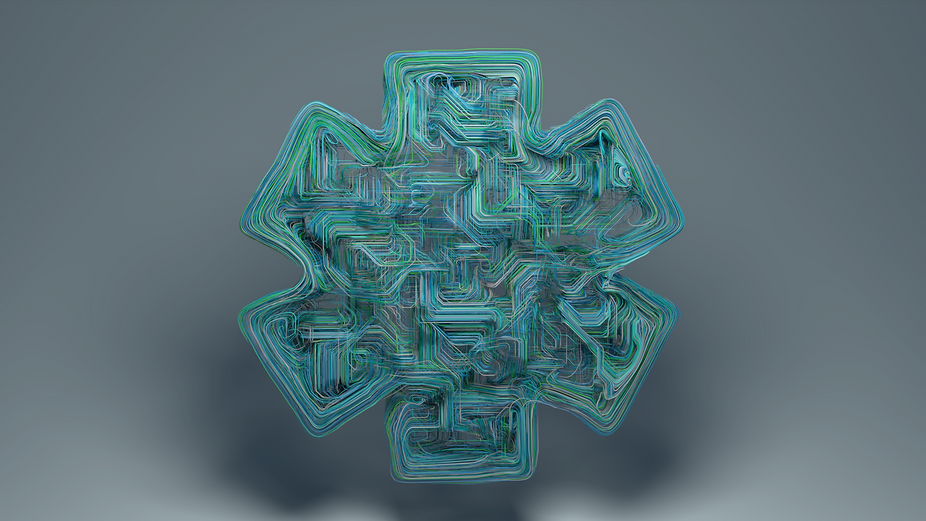
Within the Lines is a small series of procedural studies that compress restless motion into clean, iconic silhouettes. The works are primarily presented as short loops; the stills on this page are representative frames chosen to make structure, density, and boundary behavior easier to read.
Type: Procedural / Algorithm Art in Houdini
Role: Artist / Technical Director (solo)
Scope : Procedural system design (Houdini), lookdev, rendering
Concept
Each piece is built around a strict constraint: the outline remains stable, while everything inside is allowed to reorganize. The series focuses on the tension between legibility and turbulence—how much motion a simple boundary can contain before the image stops reading as a single form. By holding the silhouette constant and varying internal behaviors (density, memory/decay, boundary resistance), each work becomes a controlled test of how structure emerges from repetition.
Visual Language
As the curves loop, drift, and occasionally snap in new directions, the interior of the shape starts to feel less like a graphic icon and more like a small ecosystem. Some pieces read as fluid simulations paused mid-flow; others resemble neon wiring, nervous scribbles, or dense root systems. The outer contour holds everything together and keeps the image legible at a glance, while the interior invites slower looking and close-up inspection. From a distance the boundary holds the image as a graphic sign; up close, the loop reveals gradients of flow, clustering, and erosion.


Generative Process
Inside each shape, custom flow fields in Houdini drive thousands of curves. Vector fields are painted or generated across the silhouette and used as invisible winds that pull the lines around. Parameters such as attraction strength, noise, and decay control how tightly the curves follow the field, how quickly they forget their previous direction, and how strongly they resist touching the boundary. Small changes in these values can flip a composition from calm to turbulent or from almost solid to almost empty, turning each shape into a kind of controlled experiment in motion.

System Anatomy: From Outline to Volume
This sequence documents how a single outline is converted into a controllable spatial system. The pipeline begins with a clean silhouette and a set of geometric operations that define where structure is allowed to exist (slicing, contour bands, boolean gating). The interior is then resampled and converted into a volume representation, enabling attributes to be accumulated and propagated as a field rather than as static geometry. Once the volume carries the driving information, trajectories are generated by integrating through the field, producing a readable internal topology that remains anchored to the original boundary. The final stages focus on translating those trajectories into a coherent render—preserving the relationship between constraint (outline) and motion (field).


