

Re-envisioning
Khirbet et-Tannur
Re-envisioning Khirbet et-Tannur
Cincinnati Art Museum (2022)
Re-envisioning Khirbet et-Tannur is a digital reconstruction of a Nabataean temple created for museum-facing interpretation. Rather than presenting the site as a single fixed “answer,” the project aims to restore spatial understanding, how architecture, carved fragments, and landscape context work together—through a model designed to be explored in motion as well as in still views.
Company: Unified Field
Type: Public Screening / Digital Interpretive Media
Role:3D Artist
Scope: Modeling / LookDev / Animation /Real-Time Visualization
Viewing Experience
The work is structured to be read at multiple scales. Close shots emphasize carving, breakage, and material history; wider moves re-establish overall massing, orientation, and the temple’s relationship to the surrounding plateau and drop-offs. Camera and lighting are treated as interpretive tools—guiding attention from fragment to structure to site, so viewers can understand both detail and placement without needing specialist background.


Viewing path — wide → mid → detail
Craft Highlights
-
Evidence-forward surface treatment: erosion, breaks, and wear are preserved so damage remains legible rather than cosmetically “fixed.”
-
Scale legibility: assets and materials are tuned to hold up in close detail while still reading coherently at architectural distance.
-
Stylized context for clarity: landscape and atmosphere are simplified to support spatial comprehension and reduce visual noise.
-
Continuity across outputs: stills and moving views are designed to share the same lighting logic and material cues for consistent interpretation.

3D Collection
Temple Reconstruction
The temple model is built from surviving fragments, excavation documentation, and museum-held references. Missing portions are reconstructed through constrained comparison—using related Nabataean sites and regional stylistic patterns to propose plausible continuations without overstating certainty. Select areas remain simplified or fragmentary to preserve the reading of what is directly supported versus what is interpretive reconstruction.


Key Rebuild Views
Site & Landscape
The surrounding terrain is recreated as a contextual stage rather than a literal, survey-accurate duplicate. Broad landform cues and elevation relationships support wayfinding and viewpoint logic, helping the viewer understand why the temple reads as elevated and how the site “sits” within the regional geography.


Site Context & 3D Site
Production Pipeline
-
Reference capture (RealityScan + rotation footage): Rotation video and on-site photos provide consistent coverage. Captured lighting is treated as reference to be normalized, not copied verbatim.
-
Modeling (Maya + ZBrush): Base geometry is built and cleaned in Maya, then refined in ZBrush with targeted restoration that avoids speculative detail.
-
Texturing (Substance 3D + Photoshop): Photo-derived textures are normalized and patched in Photoshop, then authored in Substance 3D for coherent materials and readable aging.
-
Context & rendering (Houdini + Unreal + Quixel): Houdini generates lightweight terrain/vegetation context (heightfields + scattering). Assets are assembled and rendered in Unreal, with Quixel Megascans supporting environmental materials and set dressing.
-
Finish & outputs (Nuke + After Effects): Nuke compositing and AE finishing for high-res stills and animation deliverables for projection and digital interpretive use.

Workflow Overview
Research Note: Making Uncertainty Visible
A core goal is to keep interpretive uncertainty readable instead of hidden. Reconstruction decisions are treated in three tiers:
-
Evidential: directly supported by fragments and documentation
-
Inferential: extended through constrained reasoning (symmetry, pattern logic, close comparanda)
-
Speculative: proposed where evidence is insufficient, kept intentionally revisable

Interpretive Layers
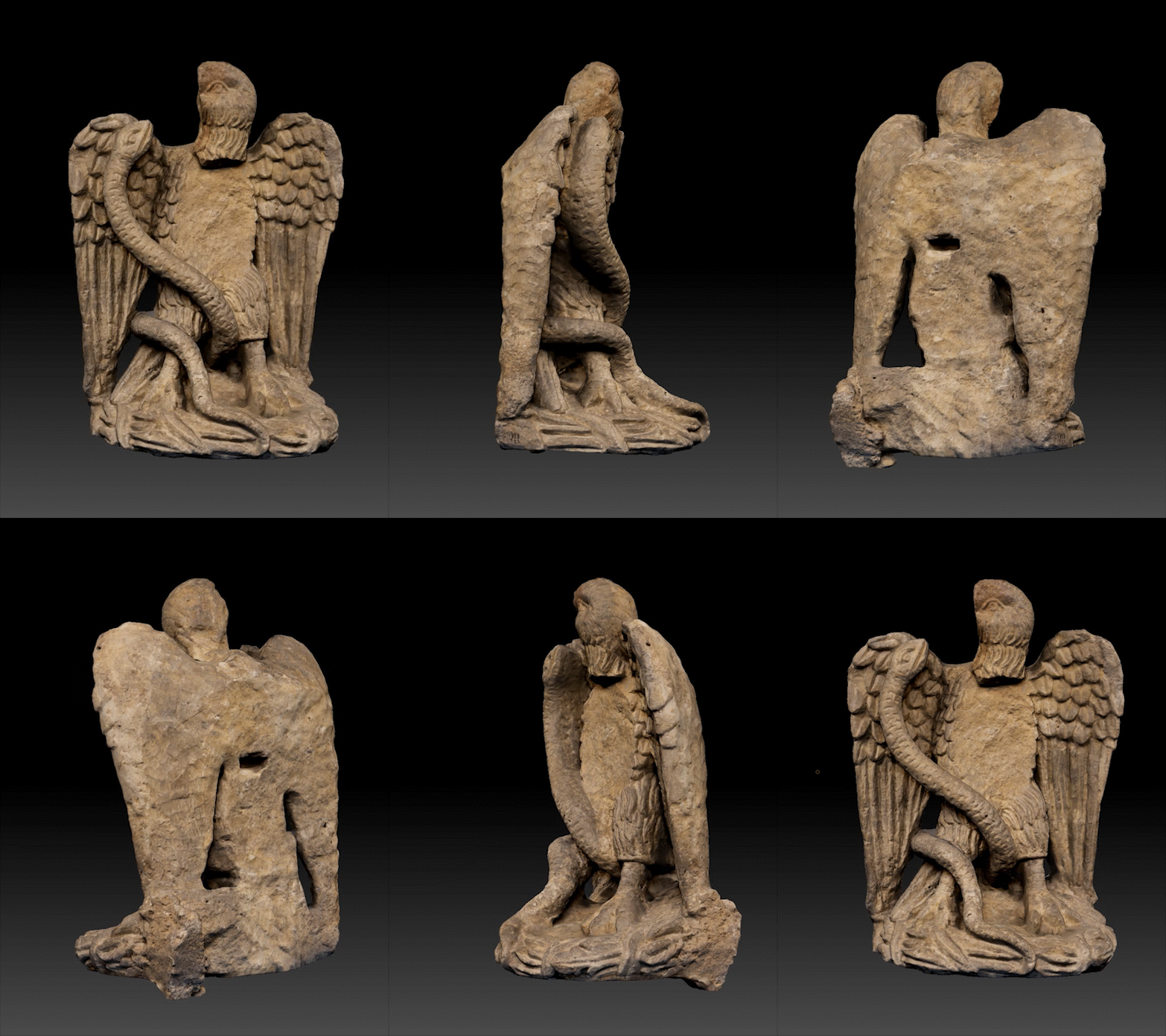
3D Model
![1939.222_[01-64].gif](https://static.wixstatic.com/media/051a51_afb833f5c6d44cb08c199cb439636d21~mv2.gif)
Original Video